
How USCIS Evaluates EB-1A Petitions Under the Final Merits Determination
1. Essential Elements of an EB-2 NIW Business Plan
An EB-1A extraordinary ability petition can be challenging to prepare, even for professionals with impressive careers, significant achievements, and years of experience. Many applicants focus on meeting at least three of the ten evidentiary criteria established by U.S. Citizenship and Immigration Services (USCIS). However, satisfying three criteria does not automatically mean that the petition will be approved.
The next important step is the EB-1A final merits determination, where USCIS evaluates the evidence as a whole to decide whether the applicant has demonstrated extraordinary ability and sustained national or international acclaim.
Understanding this process can help applicants present their achievements more effectively and avoid common weaknesses in their petitions.
Understanding the EB-1A Final Merits Determination
The EB-1A immigrant classification is intended for individuals who have risen to the top of their field, including sciences, arts, education, business, or athletics. Applicants must demonstrate extraordinary ability through extensive documentation and establish that they intend to continue working in their area of expertise in the United States.
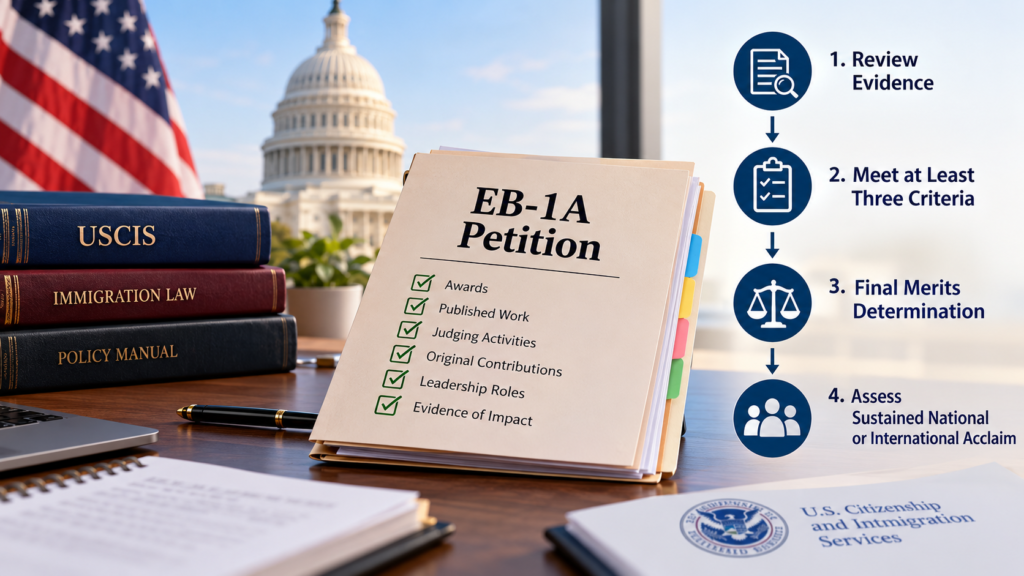
USCIS generally uses a two-step approach to evaluate EB-1A petitions.
Step 1: Meeting the evidentiary criteria
An applicant must either provide evidence of a one-time achievement, such as a major internationally recognized award, or satisfy at least three of the ten regulatory criteria, subject to the applicable evidentiary requirements.
These criteria may include receiving lesser nationally or internationally recognized awards, membership in associations requiring outstanding achievements, published material about the applicant, judging the work of others, original contributions of major significance, scholarly articles, leading or critical roles, and other qualifying evidence.
Step 2: The final merits determination
Meeting the initial criteria is only the beginning. USCIS then considers whether the evidence, taken together, establishes that the applicant has extraordinary ability and has achieved sustained national or international acclaim.
This distinction is important because an applicant may satisfy three criteria on paper but still fail to demonstrate that their overall record places them among the small percentage who have risen to the top of their field.
How USCIS Evaluates EB-1A Petitions After Meeting Three Criteria
One of the most common questions applicants ask is: how USCIS evaluates EB-1A petitions after meeting three criteria.
The answer depends on the quality, relevance, and overall significance of the evidence. USCIS does not simply count the number of documents submitted or treat every qualifying criterion as equally persuasive.
For example, an applicant may have published several scholarly articles, served as a peer reviewer, and received professional awards. These achievements may help satisfy three criteria. However, USCIS may still examine whether the awards are recognized beyond a limited organization, whether the reviewing activities demonstrate recognition of the applicant’s expertise, and whether the publications have contributed meaningfully to the field.
The central question is not merely whether the applicant has accomplished certain professional activities. It is whether those accomplishments collectively demonstrate extraordinary ability.
A well-prepared petition should therefore explain the significance of each achievement, provide independent supporting evidence where available, and connect the evidence to the applicant’s standing in the field.
1. Evidence of Sustained National or International Acclaim
The requirement for EB-1A sustained national acclaim is an important part of the final merits analysis. USCIS looks at whether the applicant has received recognition over time rather than relying solely on one isolated achievement.
Sustained acclaim does not necessarily mean that an applicant must have been famous for decades. Instead, the evidence should demonstrate that recognition of the applicant’s achievements has been maintained or developed within the relevant professional field.
For instance, an applicant may have received an important award several years ago but may have limited evidence of recognition since then. In contrast, another applicant may demonstrate a continuing record of industry recognition, invitations to judge professional work, influential publications, significant contributions, and documented recognition from independent experts.
The strength of the evidence depends on the applicant’s circumstances and field. There is no universal number of awards, citations, publications, or years of experience that guarantees approval.
Applicants should focus on demonstrating the continuing significance of their work rather than simply presenting a long list of accomplishments.
2. The Importance of Original Contributions
Original contributions can be particularly important in EB-1A petitions, especially for applicants working in technology, research, engineering, healthcare, finance, and business.
However, developing a new product, completing an internal company project, or introducing a workplace improvement does not automatically establish a contribution of major significance.
USCIS may examine what the applicant contributed, how the work differs from existing approaches, and whether the contribution has had a meaningful impact on the broader field.
For example, an engineer may have developed a new technical solution that improved a company’s internal operations. The petition becomes stronger when reliable evidence also demonstrates measurable results, adoption by other teams or organizations, industry recognition, or other evidence of broader significance, where applicable.
Supporting documents may include technical reports, independent expert letters, implementation records, performance data, patents, citations, or evidence of external adoption.
The objective is to explain not only what the applicant created but also why the contribution matters.
3. Why Independent Recognition Matters
Recommendation letters can help USCIS understand the importance of an applicant’s achievements. Nevertheless, letters alone may carry limited weight if they contain general praise without specific facts or supporting documentation.
Strong letters explain how the recommender knows the applicant’s work, identify the particular achievement being discussed, and describe its significance using concrete examples.
Independent experts who have no close professional or financial relationship with the applicant may provide useful perspectives, particularly when they can explain the impact of the applicant’s work beyond their immediate employer.
Where possible, applicants should support expert opinions with objective evidence, such as published research, industry reports, citations, awards, adoption records, or independently documented results.
The goal is not to collect the largest possible number of letters. It is to build a credible record that helps establish the applicant’s professional standing.
4. Understanding the USCIS EB1A Evaluation Process
The USCIS EB1A evaluation process involves more than reviewing whether the petition contains the required forms and supporting documents. Officers assess the evidence against the applicable regulatory requirements and determine whether the record establishes eligibility.
During the final merits determination, officers may consider the overall quality of the applicant’s achievements, the significance of awards and contributions, the credibility of supporting evidence, the extent of professional recognition, and the applicant’s standing within the field.
Evidence should tell a consistent story. If a petition claims that an applicant has made major contributions but provides no reliable evidence of their impact, the claim may be less persuasive. Similarly, a large number of publications may not establish extraordinary ability without evidence showing why the applicant’s work is significant in the relevant field.
Applicants should also avoid exaggerating achievements or presenting ordinary job responsibilities as exceptional accomplishments without supporting evidence.
A focused petition that explains the relationship between the evidence and the legal standard is generally more effective than a disorganized collection of documents.
5. Common Mistakes That Can Weaken an EB-1A Petition
Several avoidable mistakes can undermine an otherwise promising case:
- Relying only on the number of criteria: Meeting three criteria does not guarantee approval at the final merits stage.
- Submitting generic recommendation letters: Letters should identify specific achievements and explain their importance.
- Overstating the impact of internal projects: Evidence should establish the contribution’s significance rather than simply describe the applicant’s responsibilities.
- Ignoring independent recognition: Objective evidence can help establish that the applicant’s achievements are recognized beyond their immediate workplace.
- Failing to demonstrate sustained acclaim: The petition should explain the broader record of recognition, where supported by the available evidence.
- Submitting excessive, repetitive documents: Every major exhibit should have a clear purpose and support a relevant claim.
Before filing, applicants should review whether the petition establishes both the initial evidentiary requirements and the overall standard for extraordinary ability.
Conclusion
The EB-1A final merits determination is a critical stage in evaluating an extraordinary ability petition. Although satisfying at least three evidentiary criteria can establish an initial basis for eligibility, USCIS must still assess whether the complete record demonstrates extraordinary ability and sustained national or international acclaim.
Applicants should focus on the significance of their achievements, the credibility of their supporting evidence, and the broader recognition of their work. Awards, publications, judging activities, original contributions, and leadership roles become more persuasive when their importance is clearly explained and supported by reliable documentation.
A strong EB-1A petition is not simply a collection of impressive credentials. It is a carefully organized explanation of why the applicant’s achievements demonstrate a level of distinction consistent with the legal requirements.
Considering an EB-1A petition? A careful review of the evidence, identification of potential weaknesses, and a clear presentation of the applicant’s achievements can help build a more coherent case. Each petition should be evaluated individually, and no particular set of achievements guarantees approval.
Disclaimer:
This article is for general informational purposes only and does not constitute legal advice. EB-1A eligibility and petition outcomes depend on the individual facts, applicable law, and evidence submitted.