
EB-2 NIW Business Plan: Essential Elements for a Strong Petition
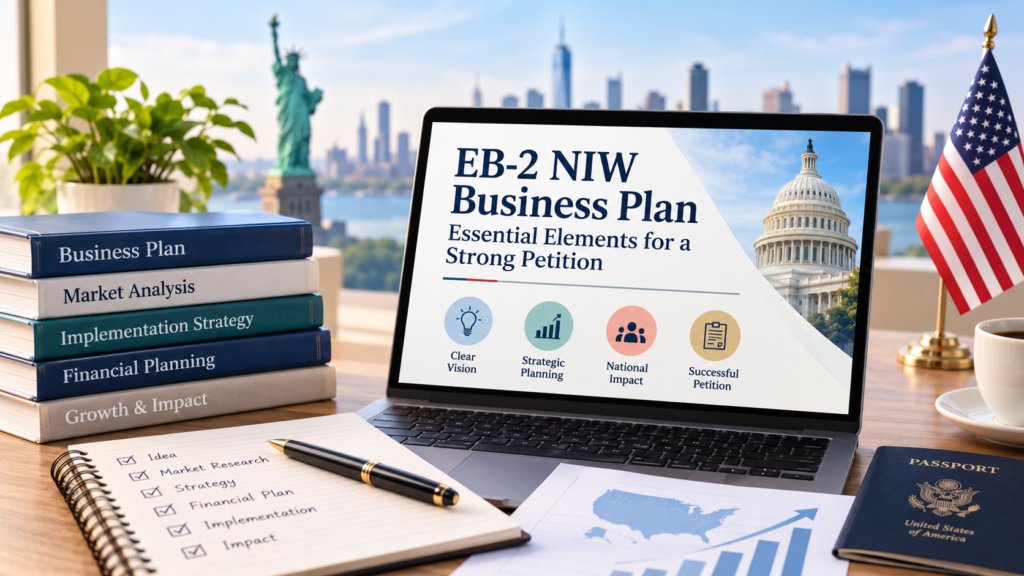
1. Essential Elements of an EB-2 NIW Business Plan
A strong EB-2 National Interest Waiver (NIW) petition requires more than professional qualifications and a promising business idea. Applicants must explain what they intend to accomplish in the United States, why their proposed work matters, and how they are prepared to move it forward.
Understanding the ssential elements of an EB-2 NIW business plan can help applicants present their proposed endeavor in a clear, organized, and credible manner. For entrepreneurs, researchers, engineers, technology professionals, and other qualified individuals, a business plan can explain how their work may contribute to an important industry or address a broader challenge affecting the United States.
A business plan should identify the proposed endeavor, describe the problem it aims to solve, outline the implementation strategy, and explain the potential benefits. It should also connect the applicant’s professional experience with the activities they intend to pursue.
For example, an entrepreneur planning to develop cybersecurity services for small businesses could explain the security challenges facing those businesses, the proposed services, the target market, and the expected outcomes. The plan should be supported by credible research and evidence rather than broad claims about future success.
2. Understanding EB-2 NIW Business Plan Requirements
The EB-2 NIW business plan requirements depend on the nature of the proposed endeavor and the evidence available in the individual case. USCIS does not prescribe one universal business plan format that guarantees approval.
Under the framework established in Matter of Dhanasar, applicants generally must demonstrate that their proposed endeavor has substantial merit and national importance, that they are well positioned to advance it, and that, on balance, waiving the job offer and labor certification requirements would benefit the United States.
A well-prepared business plan can help explain these points, but the plan alone does not establish eligibility.
Important areas to address include:
- Proposed endeavor: Clearly explain the work the applicant intends to undertake in the United States.
- National importance: Describe the endeavor’s potential broader implications, supported by relevant evidence.
- Applicant’s qualifications: Explain how the applicant’s education, experience, expertise, and achievements prepare them to advance the endeavor.
- Implementation strategy: Identify practical steps, milestones, resources, and anticipated activities.
- Market research: Demonstrate an understanding of the relevant industry, customer needs, and existing challenges.
- Financial planning: Provide realistic funding arrangements, operating expenses, and financial projections where relevant.
- Supporting evidence: Include documentation such as market research, letters of interest, business agreements, prior achievements, or evidence of funding, when applicable.
The business plan should be consistent with the petition letter, proposed endeavor statement, resume, recommendation letters, and other supporting evidence. Inconsistencies or unsupported projections can undermine the credibility of the overall presentation.
3. EB-2 NIW Business Plan Template: A Practical Structure
An EB-2 NIW business plan template can provide a useful starting point, particularly for applicants who are unsure how to organize their proposed endeavor. However, a generic template should never replace a plan tailored to the applicant’s professional background and actual objectives.
A practical outline may include the following sections:
- Executive summary: Introduce the applicant, the proposed endeavor, its objectives, and its potential significance.
- Professional background: Summarize relevant education, experience, expertise, and achievements.
- Proposed endeavor: Explain the specific work planned in the United States and the problem it aims to address.
- Industry and market analysis: Describe the relevant industry, demand, existing challenges, and potential beneficiaries.
- Products or services: Explain what the business will provide and how the proposed activities will be carried out.
- National importance: Discuss the endeavor’s potential broader impact and support the analysis with credible sources.
- Implementation timeline: Set out realistic milestones and explain how the applicant intends to progress.
- Funding and resources: Identify available funding, operational requirements, staffing needs, and other resources.
- Expected outcomes: Describe measurable objectives and anticipated results without presenting projections as guaranteed outcomes.
- Supporting documentation: Identify evidence that substantiates the applicant’s qualifications, plans, market opportunity, and progress toward implementation.
The final plan should reflect the applicant’s actual circumstances. For example, a healthcare technology entrepreneur may focus on access to healthcare and technological innovation, while a renewable energy professional may explain how their proposed activities could contribute to energy efficiency or infrastructure development.
4. Turning a Business Plan Into a Stronger Petition
A business plan becomes more useful when it is supported by evidence. Market research can help establish the context for the proposed work, while documented achievements can demonstrate the applicant’s relevant experience. Letters of interest, existing partnerships, funding evidence, and preliminary project results may also be helpful when applicable.
Applicants should avoid relying exclusively on projected revenue, job creation, or the number of customers they hope to acquire. These figures may explain the commercial viability of a business, but they do not automatically establish national importance.
Instead, the plan should explain why the proposed activities matter, who may benefit, and how the applicant is prepared to carry them out.
Ultimately, a persuasive EB-2 NIW business plan combines a clear proposed endeavor, credible research, realistic implementation steps, and evidence tailored to the applicant’s circumstances. When aligned with the legal arguments and supporting documentation, it can help USCIS evaluate the broader context of the petition.
Disclaimer:
This article provides general information and is not legal advice. EB-2 NIW eligibility depends on the applicable law and the evidence presented in each individual case.